









pewag bluetrack: The Right Traction for Every Forestry Job
pewag bluetrack: The Right Traction for Every Forestry Job
In rough terrain, traction, stability and soil protection decide whether a working day runs smoothly. pewag forestry tracks are engineered to deliver reliable grip across all subsoils while keeping ground impact to a minimum, and the pewag bluetrack family lets you match that performance to your machine, tyres and conditions.

The range spans three lines: bluetrack essential as a cost-efficient entry option, bluetrack as a versatile all-rounder, and bluetrack+ as a premium solution built for maximum service life and ride comfort. This overview explains what sets each line apart so you can choose with confidence.
3 lines, 1 family
From economical entry to premium performance – one configurable bluetrack platform covers lighter jobs through to demanding forwarder work.

The bluetrack forestry track range at a glance
Each line shares the proven bluetrack concept and 2-stub starwave® traction with offset geometry, then tunes link distance, stub size and cross-member spacing to a different priority. The table below summarises the key differences.
| bluetrack essential | bluetrack | bluetrack+ | |
|---|---|---|---|
| Positioning | Economical entry | Universal all-rounder | Premium performance |
| Link distance | Long | Medium | Short (more cross members) |
| starwave® stubs | Small | Medium | Medium |
| Best suited to | Lighter, price-sensitive jobs, second hand machines | Almost all tyres & machines | Forwarders, heavy machines, demanding work |
| Stands out for | Self-cleaning, low weight | Versatility, long lifespan, good tyre protection | Ride comfort, max lifespan, stability, very good tyre protection |
| Also available as | mono / mono skidder | mono skidder | – |
| Optional config | – | Tight-Tight ends, large stubs, ST (strong cross member) version on perfect and duro | Tight-Tight ends, large stubs, ST (strong cross member) version on perfect and duro |
pewag bluetrack essential – your entry into pewag quality
bluetrack essential is the economical way into pewag track quality. It is a strong value choice for lighter applications and price-sensitive needs, without giving up the durability the pewag name stands for.
- pewag quality at an economical price
- Long link distance for improved self-cleaning properties and reduced weight
- Small starwave® stubs for solid traction and improved wear resistance
- Additionally available as pewag mono and mono skidder track
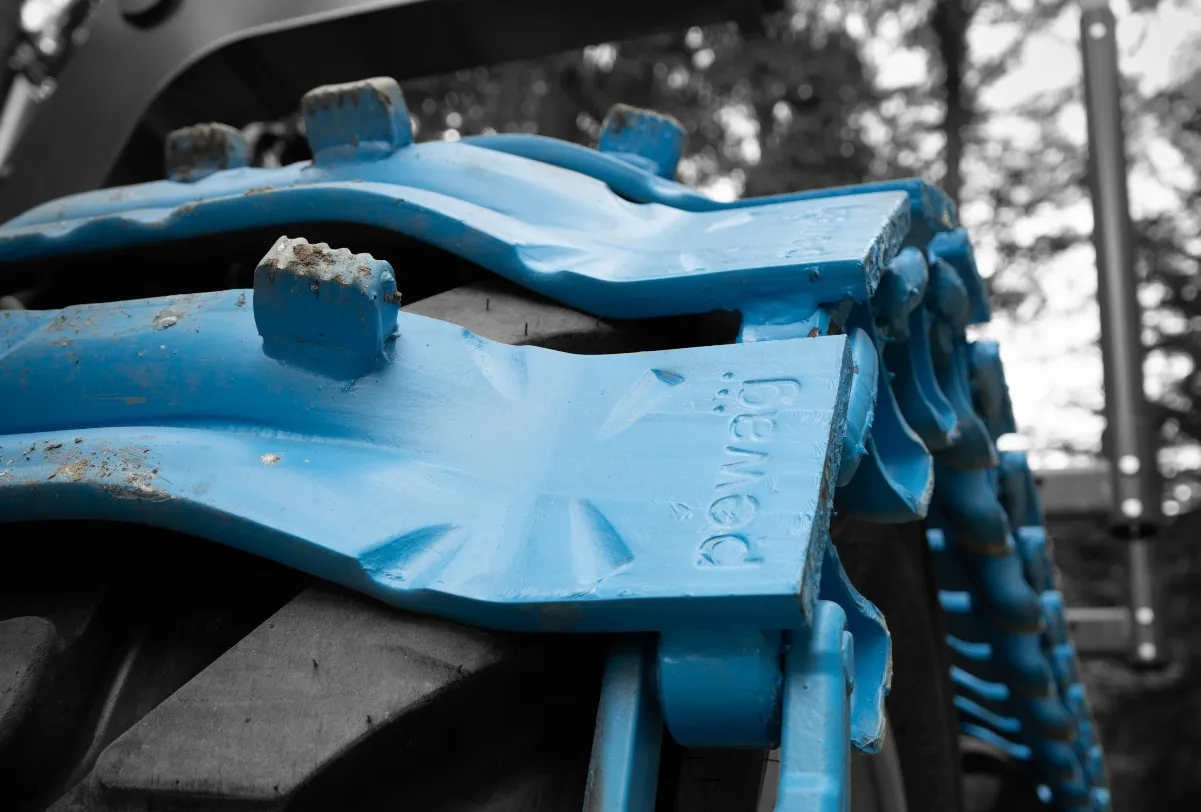
pewag bluetrack – the universal all-rounder
bluetrack is pewag’s forestry-track bestseller. Built on a proven concept with broad configurability, it is designed to fit almost all tyres, machines and conditions – the natural default for everyday forestry work.
- The universal track for almost all tyres, machinery and conditions.
- Medium link distance for higher wear resistance and good tyre protection.
- Medium starwave® stubs for more traction and improved wear resistance.
- Case-hardening process on the link system increases surface hardness for added durability.
- Optional configuration: Tight-Tight cross member ends for minimal clearance, and large starwave® stubs for maximum traction and extended lifespan. Stronger cross members (ST version) on perfect and duro for heaviest machines.
- Additionally available as mono skidder track and as ST version on bigger mono skidder tyre sizes.
pewag bluetrack+ – premium performance and smooth ride
bluetrack+ takes proven bluetrack quality and makes it smoother still, with enhanced tyre protection and the longest service life in the range. It is especially suited to demanding applications – particularly with forwarders – where a smooth ride and durability matter most.
- Designed for use with forwarders in particular.
- Short link distance with more cross members per track for excellent tyre protection and even higher wear resistance.
- Medium starwave® stubs for more traction and improved wear resistance.
- Exceptional ride comfort (a “smooth ride”) and maximum lifespan.
- Adding additional stability due to lowering the center of gravity of the machine.
- Optional configuration: Tight-Tight cross member ends for minimal clearance, and large starwave® stubs for maximum traction and extended lifespan. Stronger cross members (ST version) on perfect and duro for heaviest machines.
How to choose the right bluetrack line
As a rule of thumb: pick bluetrack essential when budget and lighter duty lead the decision, made especially for second hand machines; choose bluetrack when you want one dependable track that fits almost anything; and step up to bluetrack+ when tyre protection, ride comfort and service life (total cost of ownership) are the priority – especially on forwarders.
Both bluetrack and bluetrack+ can be configured with Tight-Tight cross member ends and large starwave® stubs when conditions demand extra traction and longevity.
Not sure which fits your machine and tyre size? pewag’s forestry experts can advise on the right specification for your conditions.
Contact a pewag forestry expert to discuss your forestry track requirements.
Forestry Track – Frequently Asked Questions
bluetrack essential is the economical entry line (long link distance, small stubs) for lighter, price-sensitive jobs. bluetrack is the universal all-rounder (medium link distance) for almost all tyres and machines. bluetrack+ is the premium line (short link distance, more cross members) for maximum tyre protection, comfort and lifespan – built especially for forwarders.
bluetrack+ is designed for forwarders in particular. Its short link distance and higher cross-member count give excellent tyre protection, a smooth ride and the longest service life.
They are the traction elements on bluetrack tracks: small on essential, medium on bluetrack and bluetrack+. Large starwave® stubs are an optional upgrade on bluetrack and bluetrack+ for maximum traction and extended lifespan. Starwave features a unique shaped stub design that delivers enhanced traction and an unmistakable look. Its profile eliminates sharp edges, reducing the risk of cutting roots and protecting the forest floor.
Yes – bluetrack is available as mono skidder track and bluetrack essential is available as a pewag mono and mono skidder track for single-wheel applications.
Discover More
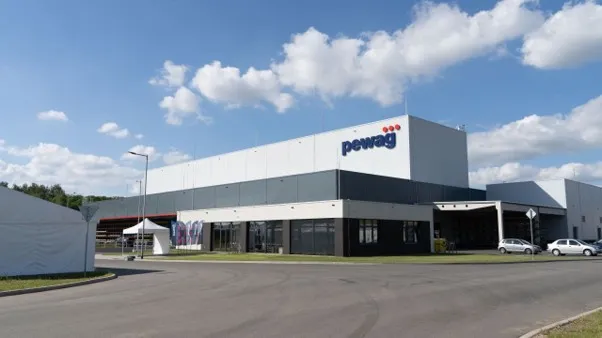
The opening of pewag’s new production facility in the Czech Republic was a chance for team members and customers to get together.
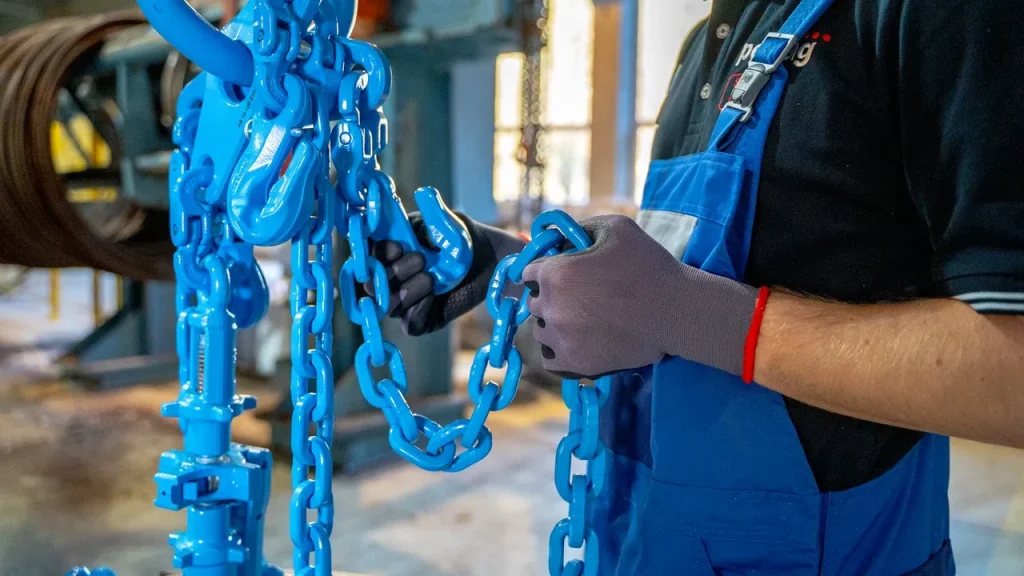
The latest innovation in chain slings is here. Introducing the G12 Plus range from pewag.
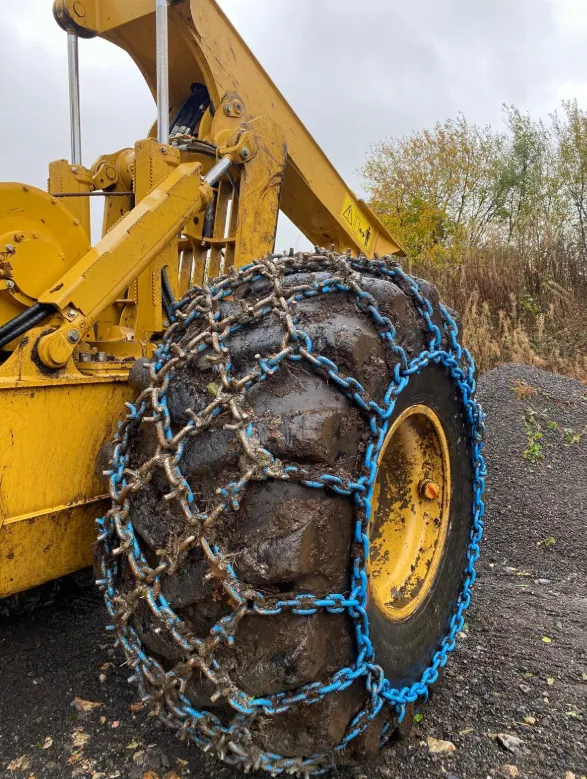
pewag has spent more than a century solving the problem of forestry traction and its forstgrip traction chains bring the latest advances to market.
pewag forstgrip Essential and Essential Pro: Dependable Traction for Everyday Forestry Work
Ask any forestry operator what keeps them up at night and tires will come up fast. A slipped chain, a punctured sidewall, a machine bogged down in clay – each one means downtime, and downtime on a harvesting contract costs real money.
pewag has spent more than a century solving exactly this problem for forestry fleets, and its forstgrip essential and forstgrip essential pro traction chains are where that experience shows up most directly: two chains built to keep machines gripping, self-cleaning and protected, whatever the ground throws at them.
Strength and innovation: manufactured in Europe
Every forstgrip chain is manufactured in Austria. Engineered for maximum durability, pewag forestry chains combine premium alloy steel with a proprietary case-hardening process, delivering exceptional wear resistance without compromising toughness and reliability.
Therefore the chain does not elongate that much which means a better fit on the tire and less tensioning. The result is a chain that lasts longer, protects the tire it’s fitted to, and keeps machines moving instead of sitting idle for repairs. Easy installation and effortless adaptation: side chains with shackles eliminate the need for additional tensioning devices, ensuring perfect chain tension, simple adjustment, and enhanced tire life due to a perfect fit.
Within that shared foundation, forstgrip essential and essential pro are pitched at slightly different jobs.
pewag forstgrip essential: the reliable all-rounder
forstgrip essential is designed as the hands-on partner for medium up to heaviest forestry machines working in genuinely difficult conditions – think clay, mud and ice rather than gentle logging roads. It benefits from:
- Improved traction on soft ground thanks to studs finished in pewag’s starwave® profile
- Excellent grip and stability, even under heavy machines on challenging terrain
- Reliable self-cleaning, courtesy of an open, wide-mesh chain design that sheds mud and debris instead of clogging up
- Longer service life from TitanGrip® special steel and case hardening
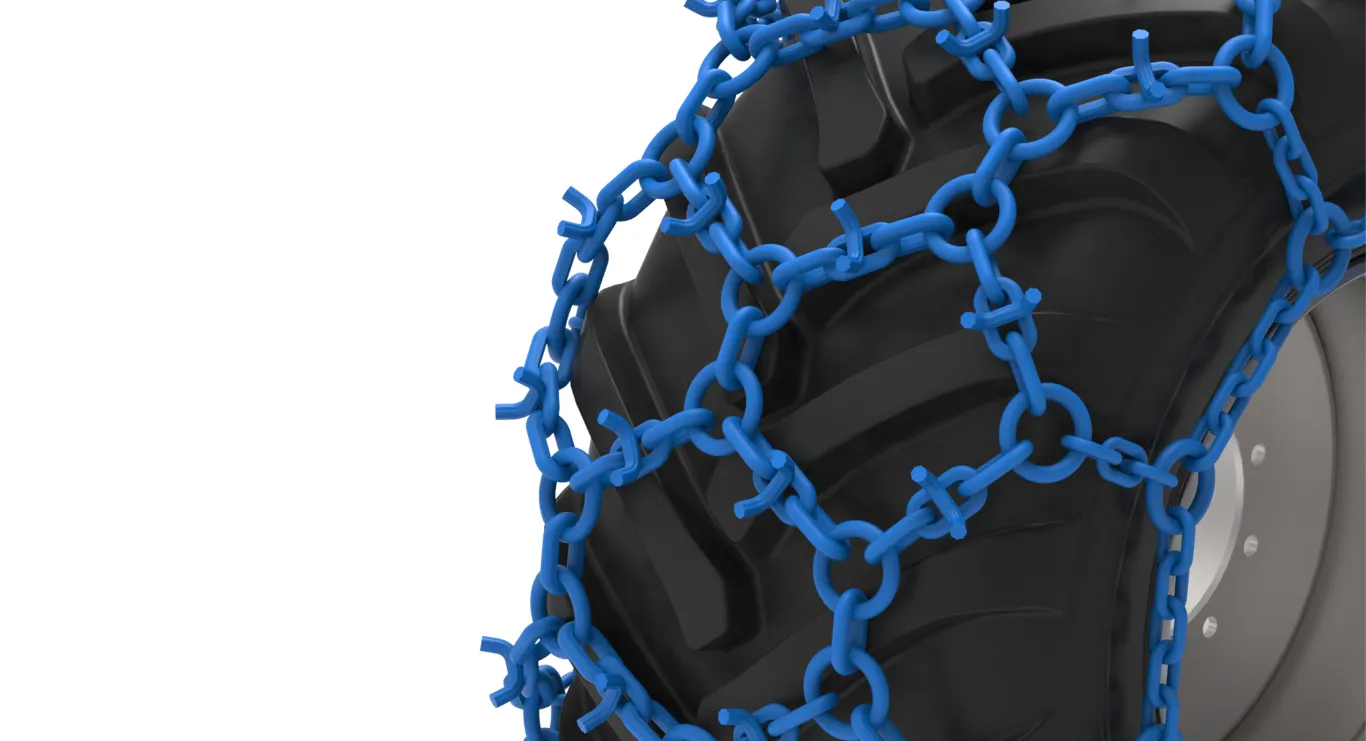
The chain is available in two thicknesses to match the machine and the job. The 16 mm version is the all-rounder for medium to heavy forestry machines, while the 18 mm version steps up to the uncompromising traction partner for the heaviest-duty applications as skidders. Both are built as a 2-field mesh design, and pewag’s ratings put forstgrip essential‘s clay/mud performance at 90% and its snow performance at 80%, with solid rock/stone grip to match – numbers that reflect a chain built to keep working when conditions turn against the operator.
pewag forstgrip essential pro: reinforced for the roughest ground
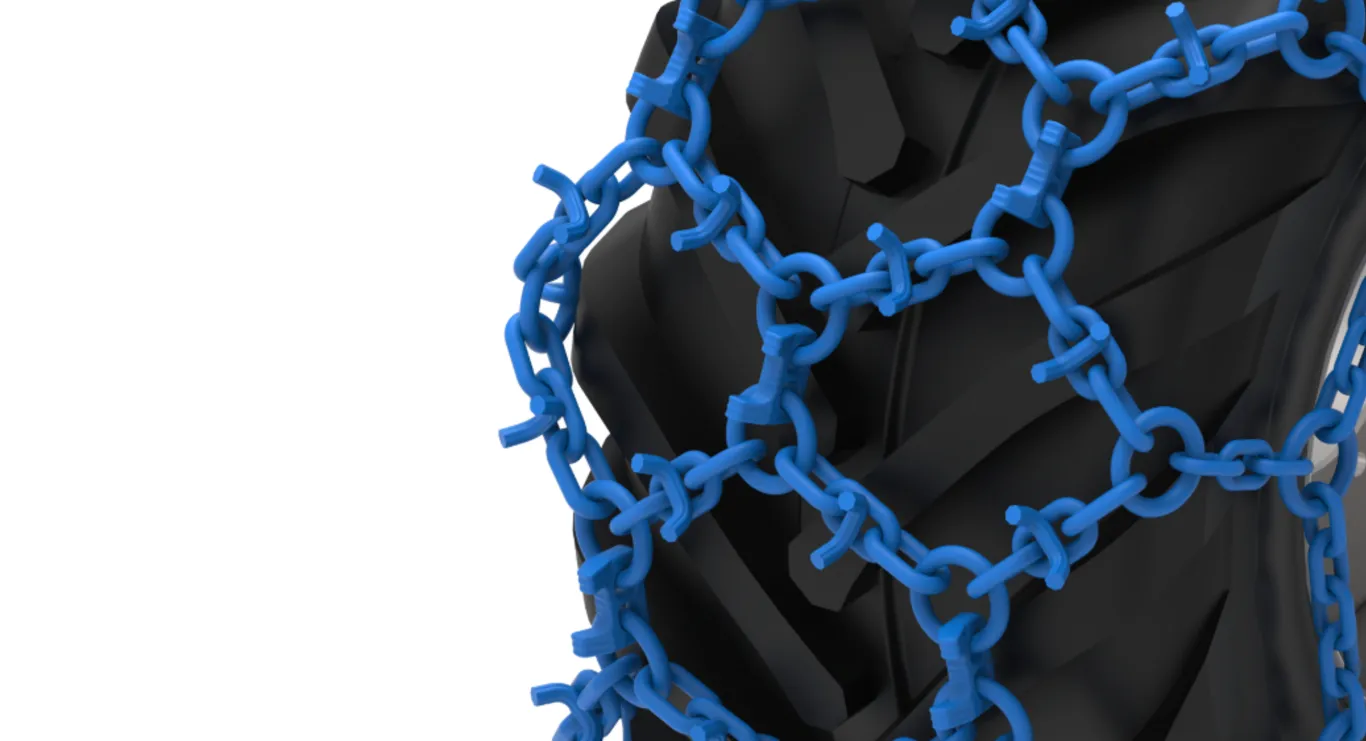
Where forstgrip essential covers soft and demanding terrain, forstgrip essential pro is the version built for medium to heavy-duty applications where the ground itself becomes the obstacle; rocky outcrops, stumps, and rough, unforgiving surfaces, in addition to the clay, mud and ice that essential already handles well.
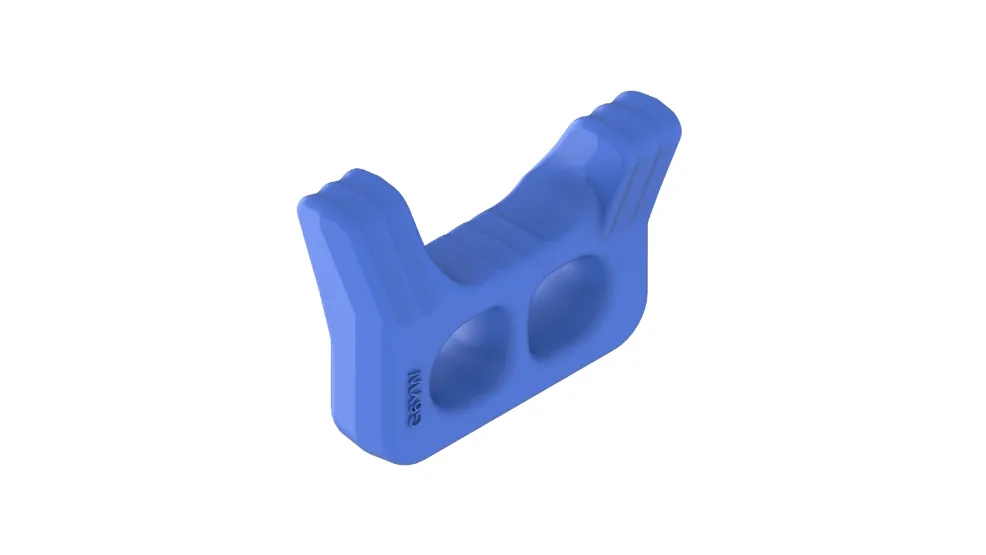
The step up comes from forged components integrated into the chain construction.
This robust design brings:
- A stronger, forged build suitable for extremely demanding, rocky and rough terrain
- Improved traction on soft ground thanks to starwave®-profile studs
- Excellent grip and high stability, even with heavy forestry machines on challenging terrain
- Uninterrupted operation thanks to the same reliable self-cleaning, wide-mesh chain design
forstgrip essential pro is supplied as a 16 mm chain in a 2-field mesh. Its rock/stone rating climbs to 90 % (compared with 80 % for standard essential), while retaining the same strong clay/mud and snow performance – a clear signal that the forged components earn their keep specifically on the harshest ground, without sacrificing everyday versatility.
Choosing between the two
In practice, the decision often comes down to what the terrain throws at the machine most often. If the working environment is dominated by mud, clay, ice and generally soft or wet conditions, forstgrip essential delivers proven traction and self-cleaning performance without extra cost. If rocky, rough or stump-strewn ground is a regular feature of the job – conditions where forged strength genuinely earns its place – forstgrip essential pro is the more resilient choice, built to shrug off impacts that would wear a standard chain faster.
Both chains share the same TitanGrip® steel, case-hardening process and self-cleaning mesh philosophy that define pewag’s forestry range, so operators aren’t trading away durability or tire protection whichever option they pick – only tuning the chain to the ground they actually work.
Beyond essential and essential pro: the wider pewag forestry range
For operators whose needs sit outside the essential and essential pro sweet spot, pewag’s forestry chain line-up offers further specialisation. forstgrip and forstgrip pro sit at the top of the range as the high-end options, combining innovative grip elements and forged parts on forstgip pro for professionals who want the outright best in safety and efficiency.
Forstgrip pro combines maximum grip, excellent wear resistance, and robust durability for tough forestry operations. The tighter net design enhances tire protection without compromising traction. Forstgrip cross utilizing only forged components is pewag’s universal crossover chain for rocky stony and hard demanding surfaces and facing changing ground conditions, while forstgrip soft and forstgrip pro soft are built with stub-free or shortened-stub geometries specifically to go easier on the soil and on logging roads, without giving up traction. Forstgrip pro soft offers excellent tire protection with minimal impact on the tire surface.
Alongside its traction chains, pewag also manufactures a full range of forestry tracks – bluetrack essential, bluetrack, bluetrack+ – for operators who need continuous tire protection and improved grip especially on soft soils rather than a chain-based solution, plus mono skidder tracks purpose-built for skidder tires.
Whatever the terrain, pewag’s forestry range is designed around the same principle: dependable traction, genuine tire protection, and equipment that keeps machines working rather than waiting on repairs. To find the right chain or track for a specific tire size and application, visit the pewag forestry chains range or get in touch with the pewag team directly.
Discover More
The opening of pewag’s new production facility in the Czech Republic was a chance for team members and customers to get together.
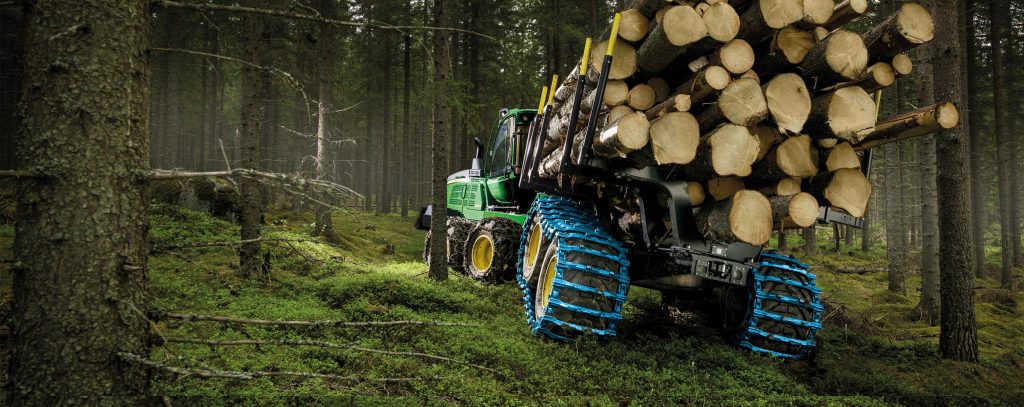
pewag forestry tracks are engineered to deliver reliable grip on forest terrain. Explore the bluetrack range.
The latest innovation in chain slings is here. Introducing the G12 Plus range from pewag.
Chains vs. Tracks for Professional Forestry Machines: How to Choose the Right Setup for Your Terrain
When a forestry machine breaks traction on a frost-softened hillside or sinks axle-deep into a boggy extraction trail, the wrong ground-engagement setup isn’t just an inconvenience, it’s lost time, damaged ground, and money left in the mud. Choosing between forestry chains and forestry tracks is one of the most consequential equipment decisions a logging operator makes, yet it often gets less attention than machine selection itself.
This article examines the key factors that should drive that choice:
- terrain
- soil
- season
- machine size
- environmental compliance
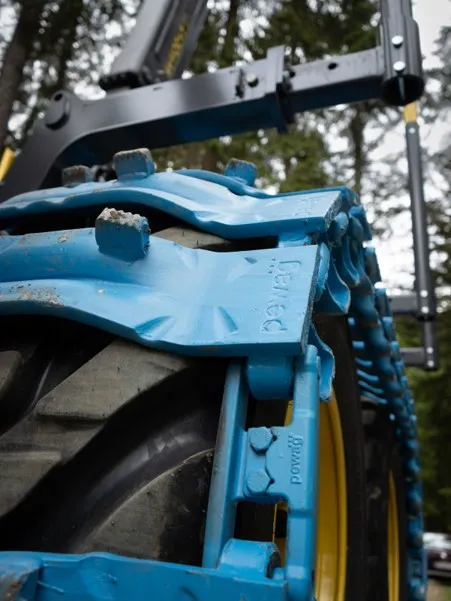
What are the Differences Between Chains and Tracks for Forestry Work?
Before diving into terrain analysis, it’s worth being precise about what “chains” and “tracks” mean in this context.
Forestry chains are steel link assemblies that wrap around the tyre, adding grip elements (studs) that bite into the ground. They protect the tyreand increase traction. They are lighter, faster to install, are lower in initial cost and have the benefit of fitting a wide range of tyre sizes – no matter what the brand.
pewag’s forstgrip chain series, for example, is developed specifically for heavy forestry application including clay, mud and ice, combining Titan-Grip steel with proven grip elements for improved stability.
Forestry tracks (also called wheel tracks or over-tyre tracks) are larger, more structured assemblies that envelop the entire tyre profile. They create a significantly wider and longer ground contact area, functioning more like a hybrid between a tyre and a crawler track.
pewag’s bluetrack lines represent this category. They are engineered for demanding forestry work, with the starwave® stub profile delivering asymmetrical traction across unpredictable subsoils.
These are not interchangeable products. They solve different problems, on different machines, in different conditions.
Chains or Tracks: How to Decide
| Tracks | Chains |
|---|---|
| Adding more stability to machines | Independent of tyre brand and wear |
| Generally better grip (soft terrain) | Better grip on hard surfaces such as ice and rocks |
| Better soil protection | Adapts better to uneven surfaces (traction) |
| Ideal option for bogie axles | Reduced width and weight for easier road transport |
| Better tyre protection | Easier to repair |
| In general, longer lasting compared to chains | Better MPG/lower fuel consumption |
| Gentler to the tyre/longer tyre lifetime | Better driving comfort |
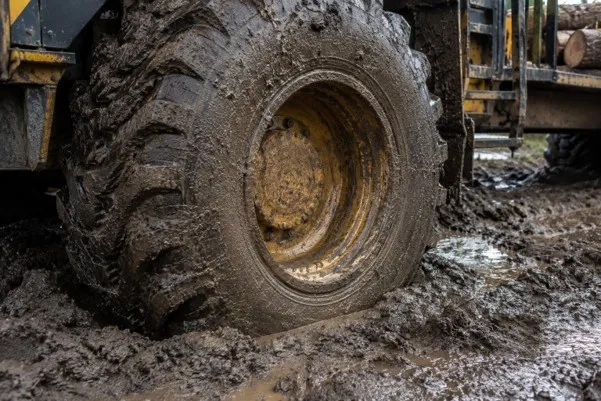
The Physics of Ground Engagement in Forestry Applications
To choose correctly, operators need to understand two competing forces: traction (the ability to drive forward) and flotation (resistance to sinking into soft ground). The relationship between them is shaped by how weight is distributed over the contact area.
Chains add grip studs that increase mechanical bite, particularly valuable on hard, icy, or rocky surfaces where the tyre needs anchor points. Tyres with chains offer flexibility on uneven ground leading to better traction, but the contact footprint does not change dramatically. On soft or wet ground, the tyre-and-chain assembly still creates a relatively concentrated load.
Tracks, by contrast, spread the machine’s weight over a much larger surface area, dramatically reducing ground bearing pressure. This is why bogie or duo tracks are the preferred choice on soft ground: they resist sinking and rutting, reducing both soil compaction and extraction time lost to stuck machines.
As a general principle, the contact area of a bogie wheel track is substantially larger than that of a chain, which enhances machine stability under heavy loads and allows operation on terrain that would be impassable for a chained forestry machine. Further stability is attained through the weight of the tracks as it lowers the centre of gravity significantly.
Terrain as the Primary Decision Driver Between Forestry Tracks and Chains
Hard, Rocky, or Frozen Ground
On firm surfaces such as rocky terrain, frozen boreal soils and compacted logging trails, chains have the advantage. The chain allows the tyre to flex over uneven terrain offering better grip, whilst the studs bite into surface irregularities and provide the grip needed to haul loads without slippage.
Tracks, while excellent in other conditions, can experience greater wear on abrasive surfaces and their larger contact area offers less advantage when the ground is already capable of supporting the machine.
For icy or hard snow-covered ground, chains are often the tool of choice. The penetrating geometry of a well-designed chain stud finds purchase where a track’s broader profile may skate. pewag forstgrip chains were specifically developed with icy conditions in mind, alongside clay and mud applications. For very demanding conditions (i.e. stones and rocks), pewag offers chains with forged parts within its forstgrip line which offer outstanding performance in terms of lifetime.
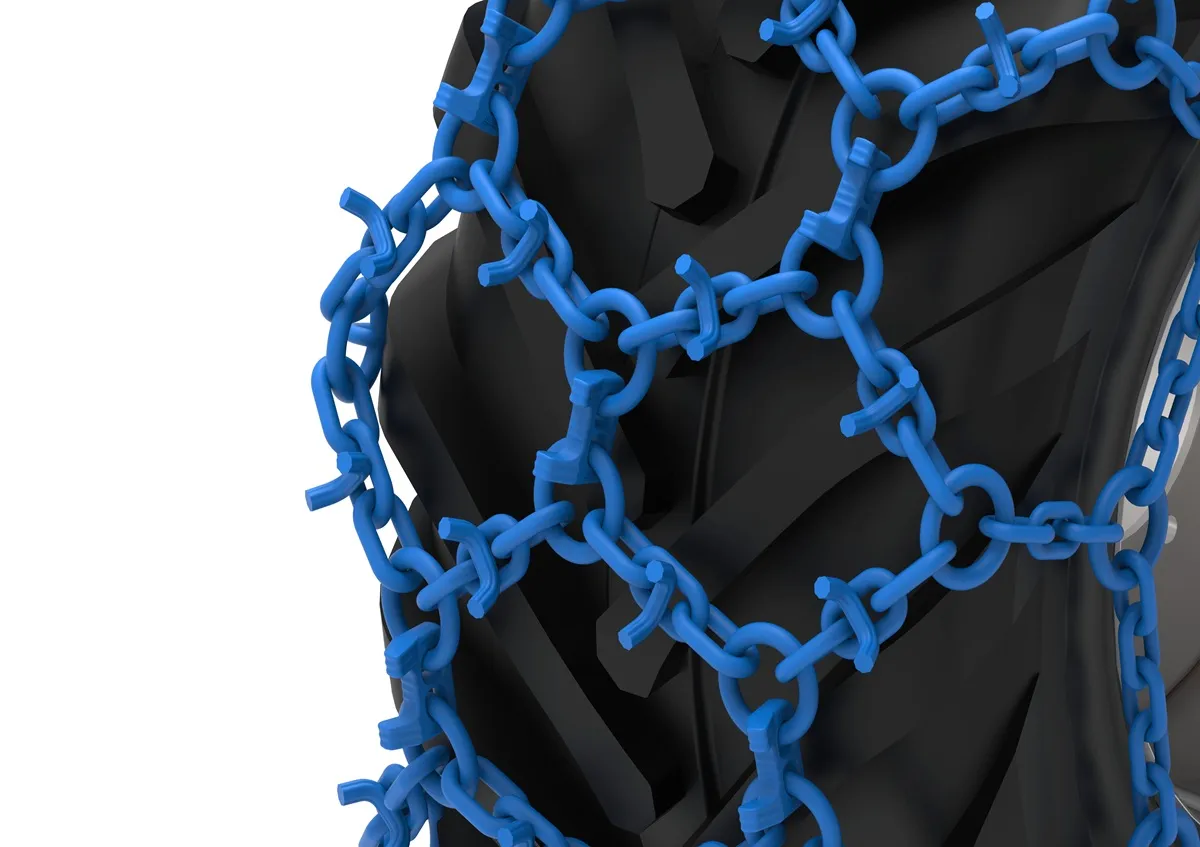
NEW forstgrip essential pro – 16 mm chain with forged parts featuring newly designed starwave ® forged parts for enhanced traction and extended service life in heavy duty application.
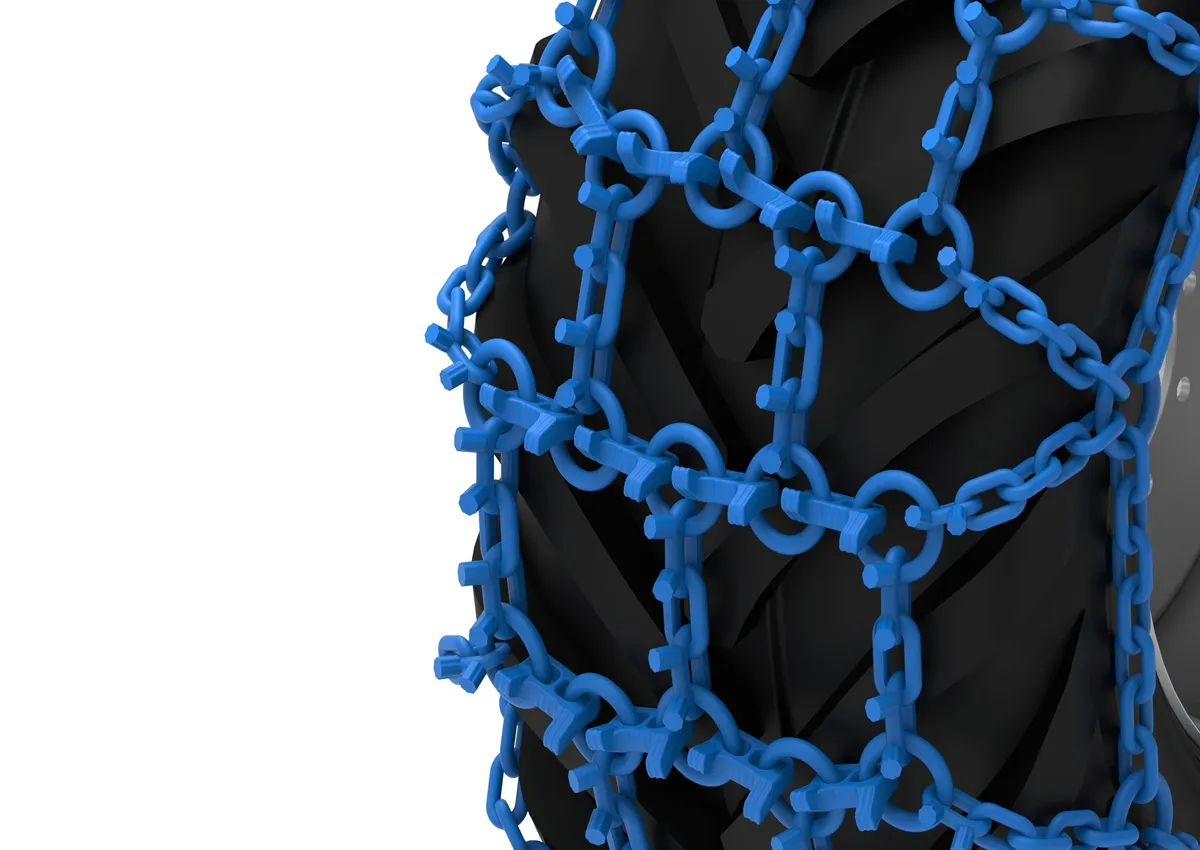
Updated forstgrip pro – 16 mm chain featuring newly designed starwave ® forged parts for enhanced traction and extended service life. Thanks to the high number of forged parts in the tread net and its tighter net design, it is ideal for heavy-duty applications in rocky and stony terrain.
Soft, Boggy, or Wet Ground
This is where bogie or duo tracks earn their premium. Soft ground such as peat bogs, wet clay or waterlogged extraction zones can punish a chained machine. The machine sinks, spins, and tears up the ground surface, creating ruts that make subsequent passes progressively more damaging. Tracks’ superior flotation keeps the machine moving and minimizes ground disturbance.
The bluetrack wave series with wave and wave wide (even wider cross member), with its wide contact surface, is specifically designed for wet or soft ground scenarios maximising flotation while still self-cleaning mud and debris from between its cross members. Self-cleaning is a critical and often underestimated feature: a chain or track that packs with mud loses its grip function rapidly.
Steep Slopes
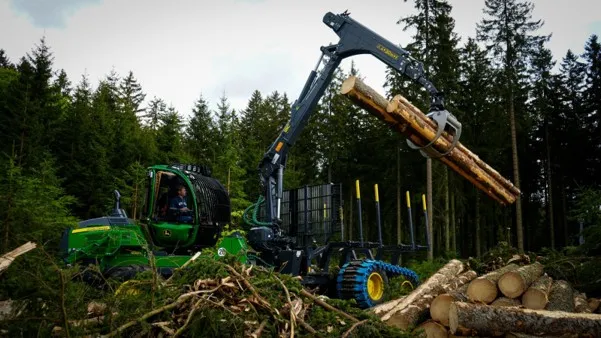
On steep or side-sloped terrain, stability and traction interact in ways that make setup selection consequential for operator safety. Track systems, with their larger footprint and improved ground contact due to stubs, offer better lateral stability particularly when operating across a slope rather than straight up or down. pewag tracks specifically offer the advantage of two stubs per cross member and an offset design, which deliver even greater grip.
The Swedish terrain classification system recognises this explicitly: driving across a side slope steeper than 15° should be avoided where possible and requires detailed planning when unavoidable. On such terrain, every increment of stability matters, and tracks tend to outperform chains.
Chains remain effective on steep terrain for machines operating along the fall line, where the primary demand is traction rather than lateral stability. For operations on very steep ground, the machine often stays closer to established trails anyway, reducing the premium on maximum flotation.
Mixed Conditions Within a Single Operation
In practice, few extraction operations have uniform terrain. A Swedish operator working the boreal interior will encounter frozen ground on north-facing slopes, waterlogged valley bottoms, exposed rock ridges, and soft organic soils sometimes within the same harvesting block. This is where product selection gets nuanced.
Many experienced operators maintain both chains and tracks and switch by season and site. Others choose a setup optimised for the dominant condition and accept lower performance in edge cases. pewag’s range, from bluetrack essential for lighter machines and retrofit applications, bluetrack as the golden middle for everything to the heavy-duty bluetrack+ series, is designed to give operators options across this spectrum without requiring separate machinery for each terrain type.
Forestry in Sweden: A Continent’s Worth of Variation in One Country
Sweden makes an ideal case study because its forestry landscape is extraordinarily demanding and diverse. Nearly 70 % of Sweden’s land area is covered in forest, with productive forestland the dominant land use. The Swedish boreal landscape is a mosaic of different land cover types, from productive coniferous forest to bog and marshland, rock surfaces and subalpine terrain.
The Terrain Classification Challenge
Swedish forestry has developed one of the world’s most detailed terrain classification systems, assessing ground conditions, surface structure, and slope. Ground conditions (the load-bearing capacity of the soil) are shaped by soil type, moisture content, and vegetation, and they vary dramatically across the country.
Northern Sweden (Norrbotten, Västerbotten, Jämtland) combines long winters, thin organic soils over bedrock, and extensive boggy terrain. Southern Sweden has heavier clay soils, milder winters, and conditions that more closely resemble Central European forestry. The central regions present intermediate conditions with seasonal variation that places high demands on both equipment and operator judgment.
The Frozen Ground Dilemma
Traditionally, a large proportion of Swedish harvesting particularly in the north was timed for winter, when frozen ground provided natural bearing capacity. Frozen soil supports machine traffic that would be impossible in summer without severe rutting and compaction damage. For decades, chains were the dominant ground engagement choice for winter Swedish skidder operations, providing grip on icy and compacted snow surfaces.
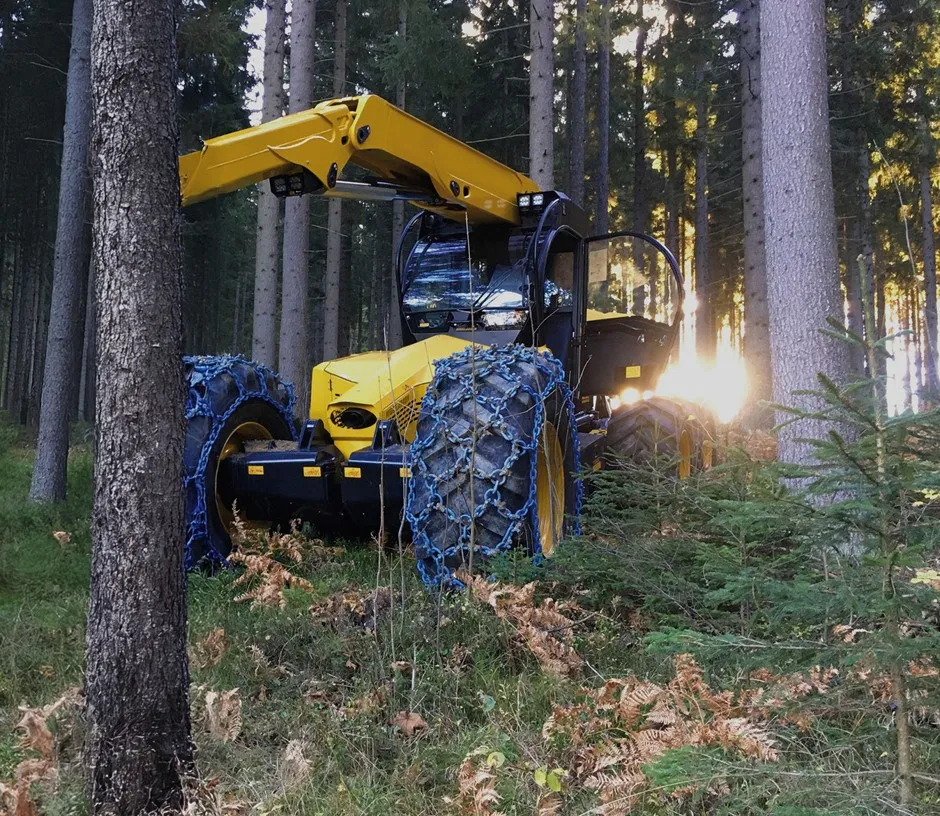
That calculus is changing. Climate research indicates that increased winter soil moisture and reduced frost frequency are beginning to reduce the carrying capacity of the soil for winter forestry operations in some regions. Warmer winters mean the frozen ground window is shortening, particularly in southern Sweden. This is pushing operations into shoulder seasons when soils are neither frozen hard nor dried out; precisely the transition conditions where flotation becomes critical.
Soil Compaction and Environmental Compliance
Swedish environmental regulation of soil disturbance in forestry is among the strictest in Europe. Rut formation, compaction, and damage to sensitive riparian zones are closely monitored, and operators face both regulatory obligations and social license pressures to minimise ground impact.
Research on Swedish harvesting operations has shown that soil type, soil moisture, traffic intensity, and road reinforcement all influence rut formation significantly. Tracks reduce surface rutting compared to chains alone, making them an increasingly important compliance tool in wet-season or sensitive-zone operations. In addition, tracks should be used for operations near watercourses, which are regulated under Sweden’s strict forest water frameworks and where minimising ground disturbance is not optional.
Seasonal Strategy: What Swedish Operators Choose
In practice, experienced Swedish forestry contractors tend to use a tiered approach:
Winter (frozen ground, snow, ice): Chains – typically forstgrip pro with forged parts for maximum bite on hard, icy surfaces where flotation is less critical than grip.
Spring thaw and autumn wet season: Tracks – particularly bluetrack duo wave for soft and wet conditions – to maintain mobility and minimise ground damage when soils are saturated.
Summer dry conditions: Light chains or bare tyres on firm, dry ground; heavier setups reserved for inclined or transitionally wet terrain.
Year-round rocky terrain: forstgrip series chain solutions with hard-wearing stubs, prioritise abrasion resistance over flotation.
This flexibility is only possible because modern track and chain systems are designed to be installed and removed in the field without specialist equipment. pewag bluetrack systems are engineered for straightforward fitting, making mid-season transitions practical rather than theoretical.
Machine Size and the Weight Factor
The choice between chains and tracks is also influenced by machine weight and class. Lighter forwarders have different footprint-to-weight ratios than heavy extraction machines, and the optimal solution differs accordingly.
For light to medium machines, pewag’s bluetrack essential line offers an accessible entry point with good traction with two stubs per cross member in the offset design and the iconic pewag starwave® profile for increased grip and off-road capability at a lower purchase price, with self-cleaning performance from the reduced number of cross beams. The bluetrack essential line is also a lightweight option which offers benefits when machines are transported on road. It’s also positioned as an ideal retrofit solution for operators adding ground protection to existing machines.
For heavy machines (especially forwarders) in demanding conditions where the machines doing the hard extraction work on steep, soft, or mixed terrain, the bluetrack+ line is designed for no-compromise performance. Two stubs with offset design per cross member, starwave® profile geometry, high-quality forged connecting elements, and case hardening all contribute to a product designed for machines that cannot afford downtime. Increased comfort due to more cross member and better stability to increased weight and finally an increased lifetime on the bluetrack+ when you think about the total cost of ownership.
A Practical Decision Framework for Forestry Traction
When selecting between chains and tracks for a given operation, five questions guide the decision:
1. What is the dominant soil bearing capacity? Hard, frozen, or rocky ground favours chains. Soft, wet, or organic soils favour tracks.
2. What is the slope profile? Steep cross-slopes increase the value of track stability. Moderate grades on firm surfaces are well-served by chains.
3. What season is the operation? Winter frozen or hard ground operations favour chains. Wet shoulder seasons, deep powder snow and summer extraction in sensitive areas, favour tracks.
4. What environmental compliance obligations apply? Operations near watercourses or on sensitive soils may require the reduced rutting profile that tracks provide.
5. What is the machine class? Match the product line to the machine weight and application intensity: bluetrack essential for lighter or retrofit applications, bluetrack as the golden middle for everything and bluetrack+ for heavy professional and demanding work.
The Cost Equation
Tracks are marginally more expensive than chains. A complete set of tracks for a forestry machine represents a higher investment, and this may be a consideration. However, the full cost analysis includes factors on both sides of the ledger.
Tracks extend tyre life by protecting the tyre from ground contact and reducing slippage-driven wear. The optimised fit of bluetrack duo tracks to tyre contours prevents the machine from sinking unnecessarily, reducing fuel consumption and improving extraction efficiency. In addition, tracks are gentler to the tyre material compared to chains. Reduced ground disturbance means fewer trail rehabilitation costs and reduced regulatory risk. In conditions where tracks prevent a stuck machine, which can cost hours of downtime and potentially require assistance, the productivity case for the higher investment becomes straightforward.
Conclusion: Terrain First, Product Second
The most experienced operators in demanding forestry environments, and Sweden is as demanding as forestry gets, understand that ground engagement is not a set-and-forget decision. It is a dynamic choice, made season by season and site by site, based on a clear-eyed reading of the terrain.
Chains remain the right answer on hard, frozen, rocky, or icy ground where grip is the limiting factor. Tracks are the right answer on soft, wet, boggy, or sensitive ground where flotation and soil protection are paramount. Many serious operations need both, used at the right time and in the right conditions.
pewag’s forestry range from forstgrip essential and forstgrip chains through bluetrack essential, bluetrack to the premium bluetrack+ line, is built on the premise that operators shouldn’t have to choose between performance and durability, or between protection of their machine and protection of the ground. The right setup for your terrain exists. Getting it right is how you stay productive, stay compliant, and stay ahead.
For product specifications, size matching, and expert guidance on chain and track selection for your machine and terrain, contact pewag’s team of experts or explore our range of forestry chains and tracks online.
Discover More
The opening of pewag’s new production facility in the Czech Republic was a chance for team members and customers to get together.
pewag forestry tracks are engineered to deliver reliable grip on forest terrain. Explore the bluetrack range.
The latest innovation in chain slings is here. Introducing the G12 Plus range from pewag.
3 user tips for forestry tracks
Maximise performance with these essential tips for optimizing forestry tracks.
Our pewag forestry tracks are very robust and a reliable companion in the forest. There are a few tips and tricks on how to significantly increase the performance and durability of the forestry tracks.
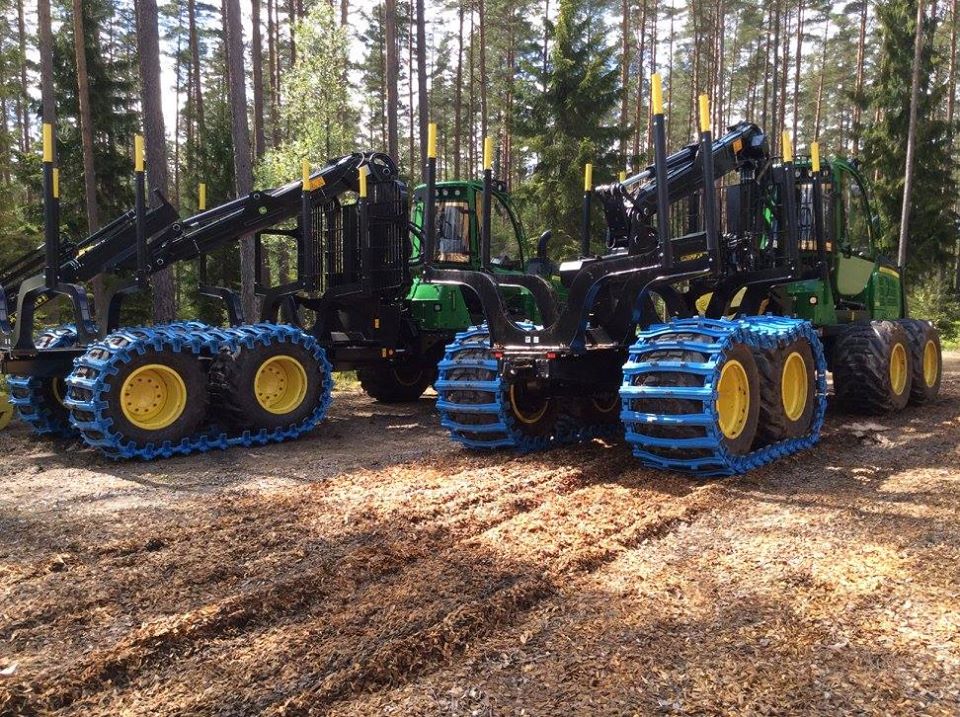
Our recommendations:
1. Use the maximum tire pressure specified by the tire manufacturer
Otherwise, the forestry tracks could slip off the machine or tire damage could occur. If the tire pressure is too low, the tire sidewall bulges outwards and can be damaged by the track. Therefore, it is essential to use the maximum tire pressure when using forestry tracks to prevent tire side damage.
2. Constantly check and adjust the tension of the forestry tracks
Correct tension of the tracks affects their performance. If it is too tight, the tire can slip in the track and the machine has less traction. If the forestry tracks are too loose, they can slide off the tire during work. For this reason: check and adjust the tension regularly!
3. Observe welding instructions when repairing or retrofitting stubs
If stubs are retrofitted or re-welded, it is particularly important to follow the pewag welding instructions. If the welding process is carried out incorrectly, the hardness surface of the cross member is impaired, and this can lead to cracks or fractures under extreme conditions. In other words, to achieve maximum performance, weld the stubs correctly according to the welding instructions!
For more security in the forest – pewag forestry products!
We are pleased to give you advise and help you to find your forestry product. Write an email to forestry@pewag.com or call our customer service +43 505011 – 0 for further assistance.
More details about our forestry products.
pewag has spent more than a century solving the problem of forestry traction and its forstgrip traction chains bring the latest advances to market.

Your trusted companions on snow and ice, ensuring safe and efficient operations in challenging conditions.
pewag forestry tracks are engineered to deliver reliable grip on forest terrain. Explore the bluetrack range.
Perfect Solutions for Autumn’s Challenging Ground Conditions
Autumn brings unpredictable conditions for forestry professionals. Overnight frosts harden the ground, daytime sun softens it again, and frequent rain turns terrain into mud. These constant shifts make reliable traction essential — not just for productivity, but for safety.
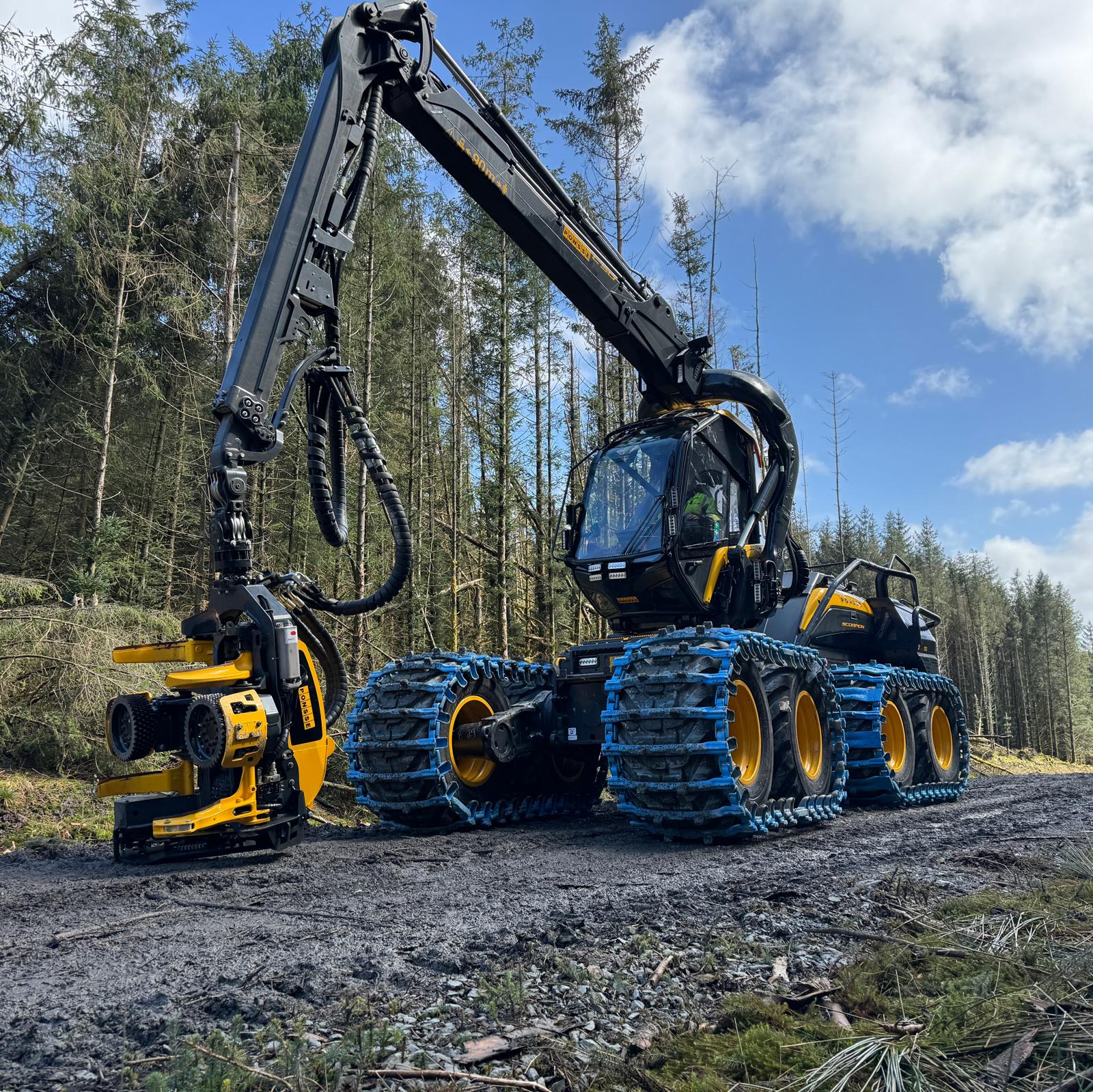
Why choose pewag bluetrack flow-perfekt?
The pewag bluetrack flow-perfekt is the ultimate all-rounder in forestry tracks, designed specifically for varying terrain and rapidly changing conditions. Its perfekt-cross member profile delivers outstanding stability and traction on hillsides, while the flow-cross member profile ensures smooth, effortless operation on soft or muddy ground. It’s exactly this combination that makes it the ideal choice for autumn forestry work — even with the heaviest machines.
Available in mono and duo track configurations, with 16 mm and 20 mm cross member thicknesses.
Explore more details:
pewag bluetrack mono flow-perfekt
pewag bluetrack duo flow-perfekt
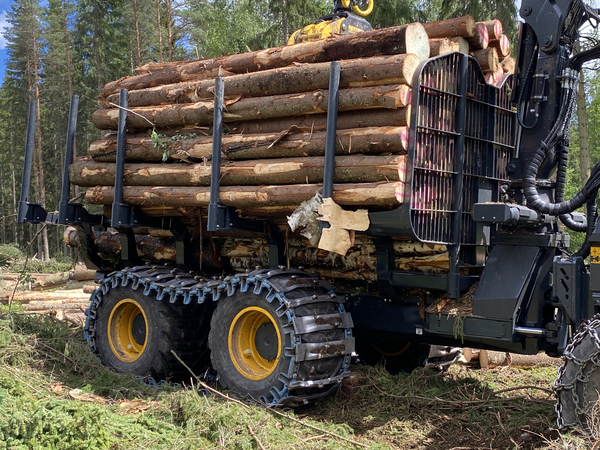
A reliable partner in autumn: pewag forestry chains
For operations where a track isn’t required, pewag’s forestry chains are an excellent alternative.
pewag forstgrip is engineered for soft and muddy terrain. Its wide mesh design offers excellent self-cleaning properties, while the angled stub arrangement provides optimised grip and stability across rough ground.
pewag forstgrip cross is built for large forestry machines. Featuring a range of forged components and an angled stub arrangement, it delivers superior grip and self-cleaning performance on soft terrain.
Explore more details:
pewag forstgrip
pewag forstgrip cross
Get expert advice
Our team is ready to help you find the right forestry product for your needs. Email us at forestry@pewag.com or call customer service on +43 505011 – 0.
More details about our forestry products.
pewag forestry tracks are engineered to deliver reliable grip on forest terrain. Explore the bluetrack range.

pewag launches a new product line, prac chain forestry chains, tailored for efficient forestry operations.
This article examines the key factors that drive the choice between chains and tracks for forestry vehicles.
Already prepared for winter season?
Your reliable companions on snow and ice: pewag bluetrack perfekt as well as pewag forstgrip and forstgrip pro
Days are getting shorter, and nights are getting longer – this signals that winter is coming soon! In snowy and icy conditions forestry professional need strong traction to work safely in the forest. In addition, higher traction leads to more productivity and to better economic success because moving the machine is much easier and work can be done much faster. The time is now to prepare your forestry machine for the winter season with pewag forestry equipment.
For winter conditions pewag recommends the forestry track pewag bluetrack perfekt and the traction chains pewag forstgrip as well as pewag forstgrip pro.
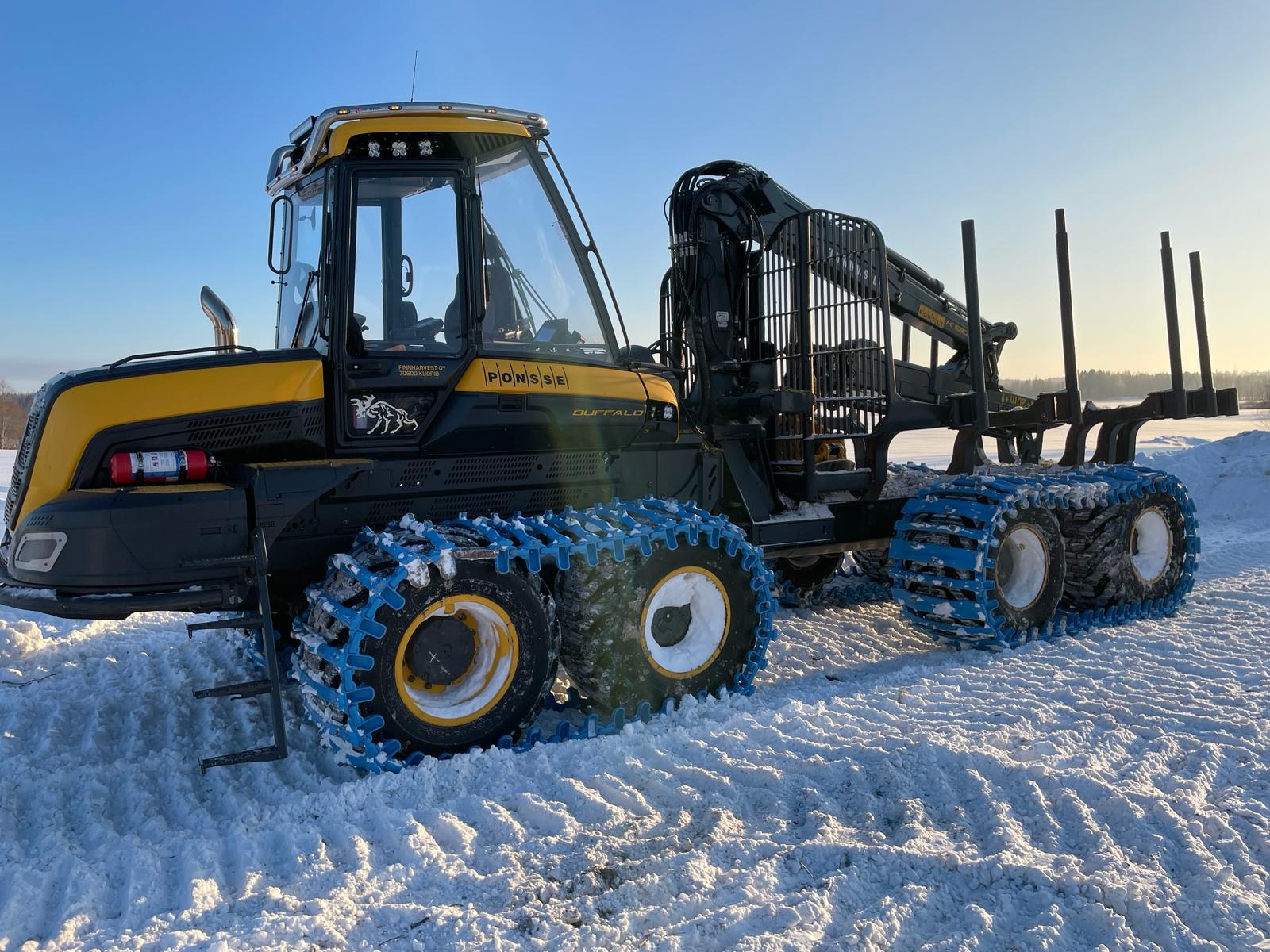
Forestry track: pewag bluetrack perfekt
Developed for steep and rocky terrain – even in snowy and muddy conditions.
- Optimised grip on steep and rocky terrain
- Reliable protection against tyre damage
- improved traction between track and tyre
Explore more details:
pewag bluetrack perfekt
Forestry chains: pewag forstgrip und pewag forstgrip pro
pewag forstgrip
Developed for soft and muddy terrain – even for snowy conditions.
- Excellent self-cleaning power
- Optimised traction thanks to angled stub arrangement
- Available in 3 strengths – 10.5mm/12.5mm/15.5mm
pewag forstgrip pro
Developed for hard, rocky terrain and icy conditions.
- Strong grip thanks to forged parts and spikes
- Excellent tyre protection
- Optimised grip thanks to angled stub arrangement
- Available in 3 strengths – 10.5mm/12.5mm/15.5mm
Explore more details:
pewag forstgrip
pewag forstgrip pro
For more security in the forest – pewag forestry products!
We are pleased to give you advise and help you to find your forestry product. Write an email to forestry@pewag.com or call our customer service +43 505011 – 0 for further assistance.
More details about our forestry products.
New fully automatic production site for pewag bluetracks
pewag produces in Vamberk, Czech Republic, forestry bogie and single wheel tracks with state-of-the-art robots according to highest quality standards.
The production site in Vamberk was renovated and modernized in 2018. In addition, in 2020 a showroom for customer meetings was built. The state-of-the-art robot technology enables precise production methods and guarantees a consistent quality level of all our forestry products.
The combination of high-quality materials, many years’ production experience and sophisticated production processes turn our bluetracks into reliable partners for forestry applications. 7 different profile types are produced daily in Vamberk and delivered worldwide at the present time.
How does the production process of pewag bluetracks look like? Let’s have a look behind the scenes!
Each bluetrack consists of cross members with studs, connecting links, locks and c-links with side support.

Cross members are the core elements of each track which consists of different components. Depending on the type of cross member profile rods are cut to the length required. Afterwards the steel blank is heated. The robot puts the blank into the press which brings the cross member into the right shape.
Very important are the stubs. The number and position of the stubs on the track are flexible and can vary. pewag places two stubs on each cross member as standard. The stubs are produced from the same material as the cross member, pressed into shape and welded on the cross member by robots.
The cross members are connected with each other through connecting links and locks.
Another important component are c-links which are influencing the lifespan of the track. The more robust they are, the longer the track can be used. The c-link is produced on an especially developed machine which is cutting, heating mand shaping the c-link.
Within the c-link the side support is integrated which is closing the link system. This side support keeps the track on the wheel and is the last step of assembling the track. For producing the side support, the raw material is punched and pressed by a fully automatic machine.
The stubs, c-links and locks are core hardened by pewag to make them more robust. This special treatment requires a lot of know how to achieve the best combination of case-hardened surface and rough core.
Each bluetrack is dipped into a special blue paint to protect the finished bluetrack from rust. After drying the track is fixed on pallets and the finished track is shipped or stored in the warehouse.


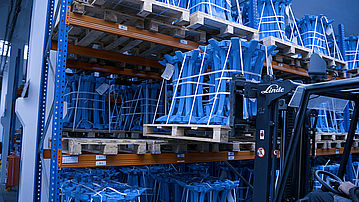
New showroom for customer visits
A new showroom was designed directly at the production site, which presents in detail all components of our bluetracks. In the future all our customer meetings are held in this modern and relaxed atmosphere. In addition, a big video wall and a coffee corner are set up to entertain our guests.
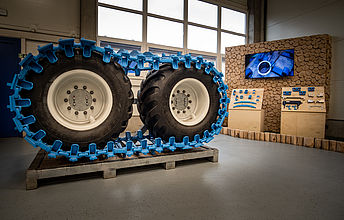

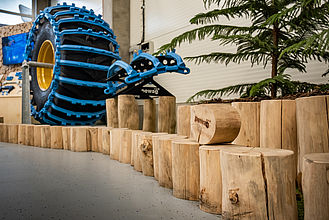
For more security in the forest – pewag forestry products!
We are pleased to give you advise and help you to find your forestry product. Write an email to forestry@pewag.com or call our customer service +43 505011 – 0 for further assistance.
More details about our forestry products.
pewag forestry tracks are engineered to deliver reliable grip on forest terrain. Explore the bluetrack range.
pewag has spent more than a century solving the problem of forestry traction and its forstgrip traction chains bring the latest advances to market.
This article examines the key factors that drive the choice between chains and tracks for forestry vehicles.
pewag forestry Pushes Resource-Saving Manufacturing
Surplus material during production is 100 % recycled
In the production of forestry chains and forestry tracks, 100 % of the surplus material is recycled when the cross members are cut off. The raw steel for the cross members is delivered in bars as yard goods and the cross members are cut off from it. Depending on the type of cross member, a piece of residual material remains which cannot be used for any other cross member.
in order to avoid remelting this residual material and reprocessing it at high energy cost, pewag uses it to manufacture the stubs for the forestry tracks. In this way, we ensure that materials are used without residues and resource-saving production is guaranteed.
For more security in the forest – pewag forestry products!
We are pleased to give you advise and help you to find your forestry product. Write an email to forestry@pewag.com or call our customer service +43 505011 – 0 for further assistance.
More details about our forestry products.
In Vamberk, Czech Republic, pewag manufactures forestry bogie and single wheel tracks using cutting-edge robotic technology, adhering to the highest quality standards.
How to achieve maximum performance
Your trusted companions on snow and ice, ensuring safe and efficient operations in challenging conditions.
pewag introduces new product line: pewag prac chain forestry chains
In addition to the forstgrip premium line for professional use, pewag is launching a basic line for hands-on applications.
Our pewag prac chain forestry chains are a reliable quality product and are always a sensible companion in the forest. The products of the new prac chain line are for users who are looking for reliable basic equipment for forestry work, but not for special use under demanding conditions. For these kinds of conditions, the forstgrip line is the ideal choice as it is offering a large selection of stubs, spikes, forged parts and field designs specifically developed for the respective area of application.
How does the forstgrip line differ from the prac chain line?
Our pewag forstgrip products were specially developed for professional use under demanding conditions and form the premium line for pewag forestry chains:
– Superior grip and stability thanks to innovative grip elements
– Longer lifespan thanks to pewag special steel TitanGrip®
– Optimised fit of the chain on the tyre
– Anti-twist protection prevents tyre damage
– Superb self-cleaning properties
– Customer-focused service worldwide
– Perfected, state-of-the-art pewag forstgrip quality
Compared to this, the pewag prac chain line was introduced for use under simpler conditions and is considered the practical basic line for forestry chains from pewag:
– Good grip and increased stability thanks to tried-and-tested grip elements
– Longer lifespan thanks to pewag special steel TitanGrip®
– Optimised fit of the chain on the tyre
– Anti-twist protection prevents tyre damage
– Reliable self-cleaning properties
pewag prac chain 16 as the first chain in the prac chain line
The prac chain 16 model convinces as a practical companion for reliable traction for medium to heavy forest machines. The 16 mm thick chain offers good traction even on clay, mud and ice and provides a reliable self-cleaning power. Thanks to the spikes in the starwave® profile, traction is improved, especially on soft ground.
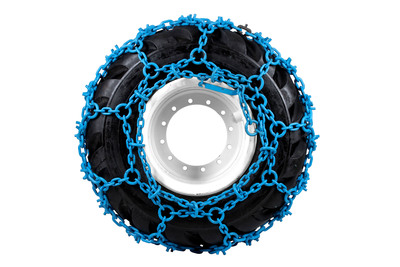
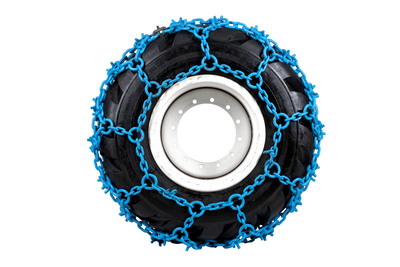
For more security in the forest – pewag forestry products!
We are pleased to give you advise and help you to find your forestry product. Write an email to forestry@pewag.com or call our customer service +43 505011 – 0 for further assistance.
More details about our forestry products.

Forestry experts need dependable traction to work safely. pewag bluetrack flow-perfect delivers optimal performance on rugged terrain.
pewag forestry tracks are engineered to deliver reliable grip on forest terrain. Explore the bluetrack range.
This article examines the key factors that drive the choice between chains and tracks for forestry vehicles.