





Chains vs. Tracks for Professional Forestry Machines: How to Choose the Right Setup for Your Terrain
When a forestry machine breaks traction on a frost-softened hillside or sinks axle-deep into a boggy extraction trail, the wrong ground-engagement setup isn’t just an inconvenience, it’s lost time, damaged ground, and money left in the mud. Choosing between forestry chains and forestry tracks is one of the most consequential equipment decisions a logging operator makes, yet it often gets less attention than machine selection itself.
This article examines the key factors that should drive that choice:
- terrain
- soil
- season
- machine size
- environmental compliance
What are the Differences Between Chains and Tracks for Forestry Work?
Before diving into terrain analysis, it’s worth being precise about what “chains” and “tracks” mean in this context.
Forestry chains are steel link assemblies that wrap around the tyre, adding grip elements (studs) that bite into the ground. They protect the tyreand increase traction. They are lighter, faster to install, are lower in initial cost and have the benefit of fitting a wide range of tyre sizes – no matter what the brand.
pewag’s forstgrip chain series, for example, is developed specifically for heavy forestry application including clay, mud and ice, combining Titan-Grip steel with proven grip elements for improved stability.
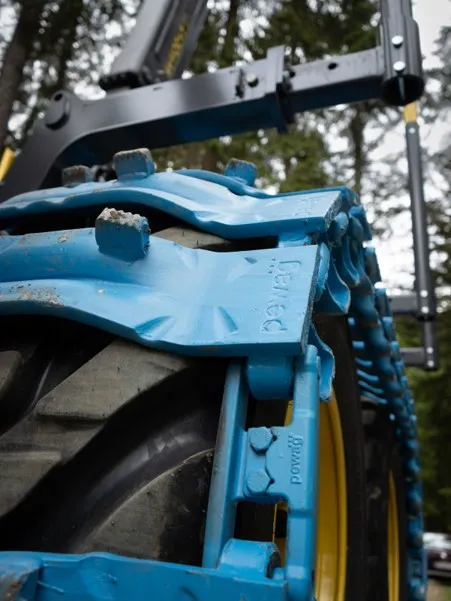
Forestry tracks (also called wheel tracks or over-tyre tracks) are larger, more structured assemblies that envelop the entire tyre profile. They create a significantly wider and longer ground contact area, functioning more like a hybrid between a tyre and a crawler track.
pewag’s bluetrack lines represent this category. They are engineered for demanding forestry work, with the starwave® stub profile delivering asymmetrical traction across unpredictable subsoils.
These are not interchangeable products. They solve different problems, on different machines, in different conditions.
Chains or Tracks: How to Decide
| Tracks | Chains |
|---|---|
| Adding more stability to machines | Independent of tyre brand and wear |
| Generally better grip (soft terrain) | Better grip on hard surfaces such as ice and rocks |
| Better soil protection | Adapts better to uneven surfaces (traction) |
| Ideal option for bogie axles | Reduced width and weight for easier road transport |
| Better tyre protection | Easier to repair |
| In general, longer lasting compared to chains | Better MPG/lower fuel consumption |
| Gentler to the tyre/longer tyre lifetime | Better driving comfort |
The Physics of Ground Engagement in Forestry Applications
To choose correctly, operators need to understand two competing forces: traction (the ability to drive forward) and flotation (resistance to sinking into soft ground). The relationship between them is shaped by how weight is distributed over the contact area.
Chains add grip studs that increase mechanical bite, particularly valuable on hard, icy, or rocky surfaces where the tyre needs anchor points. Tyres with chains offer flexibility on uneven ground leading to better traction, but the contact footprint does not change dramatically. On soft or wet ground, the tyre-and-chain assembly still creates a relatively concentrated load.
Tracks, by contrast, spread the machine’s weight over a much larger surface area, dramatically reducing ground bearing pressure. This is why bogie or duo tracks are the preferred choice on soft ground: they resist sinking and rutting, reducing both soil compaction and extraction time lost to stuck machines.
As a general principle, the contact area of a bogie wheel track is substantially larger than that of a chain, which enhances machine stability under heavy loads and allows operation on terrain that would be impassable for a chained forestry machine. Further stability is attained through the weight of the tracks as it lowers the centre of gravity significantly.
Terrain as the Primary Decision Driver Between Forestry Tracks and Chains
Hard, Rocky, or Frozen Ground
On firm surfaces such as rocky terrain, frozen boreal soils and compacted logging trails, chains have the advantage. The chain allows the tyre to flex over uneven terrain offering better grip, whilst the studs bite into surface irregularities and provide the grip needed to haul loads without slippage.
Tracks, while excellent in other conditions, can experience greater wear on abrasive surfaces and their larger contact area offers less advantage when the ground is already capable of supporting the machine.
For icy or hard snow-covered ground, chains are often the tool of choice. The penetrating geometry of a well-designed chain stud finds purchase where a track’s broader profile may skate. pewag forstgrip chains were specifically developed with icy conditions in mind, alongside clay and mud applications. For very demanding conditions (i.e. stones and rocks), pewag offers chains with forged parts within its forstgrip line which offer outstanding performance in terms of lifetime.
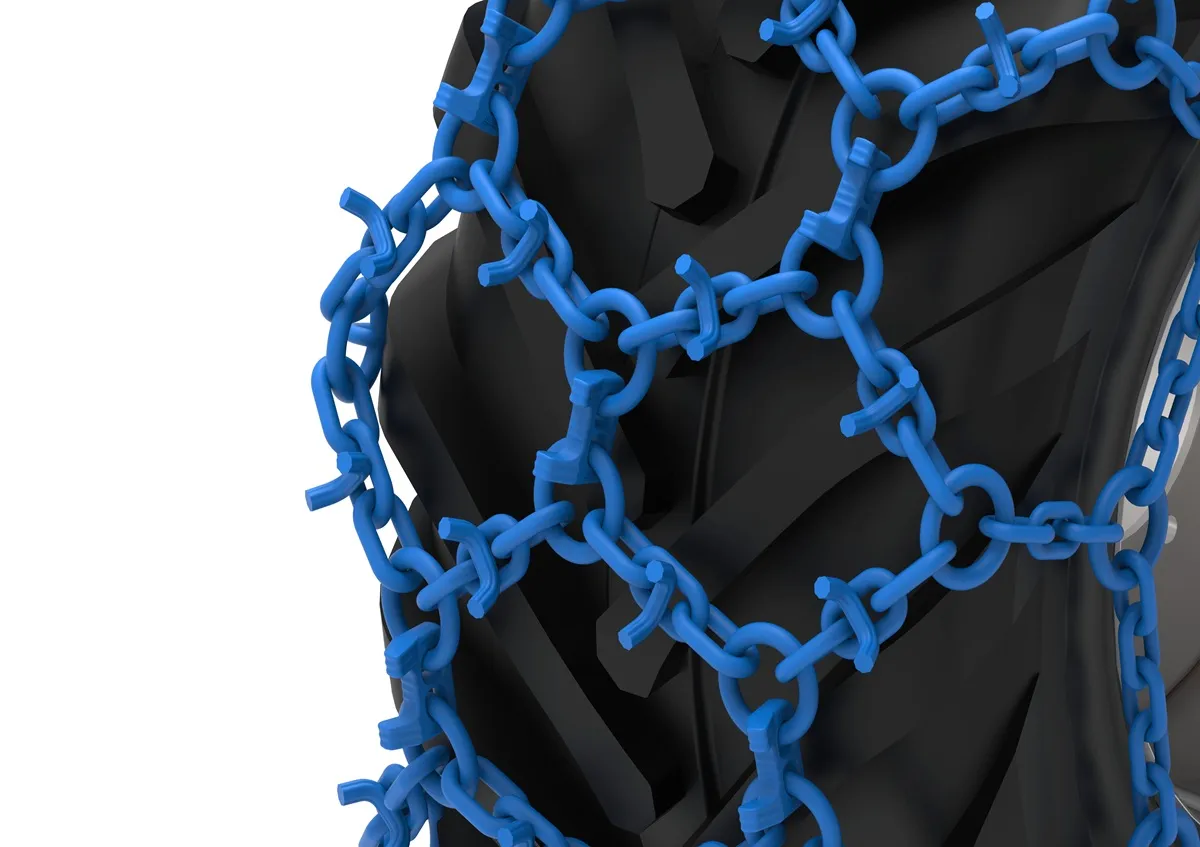
NEW forstgrip essential pro – 16 mm chain with forged parts featuring newly designed starwave ® forged parts for enhanced traction and extended service life in heavy duty application.
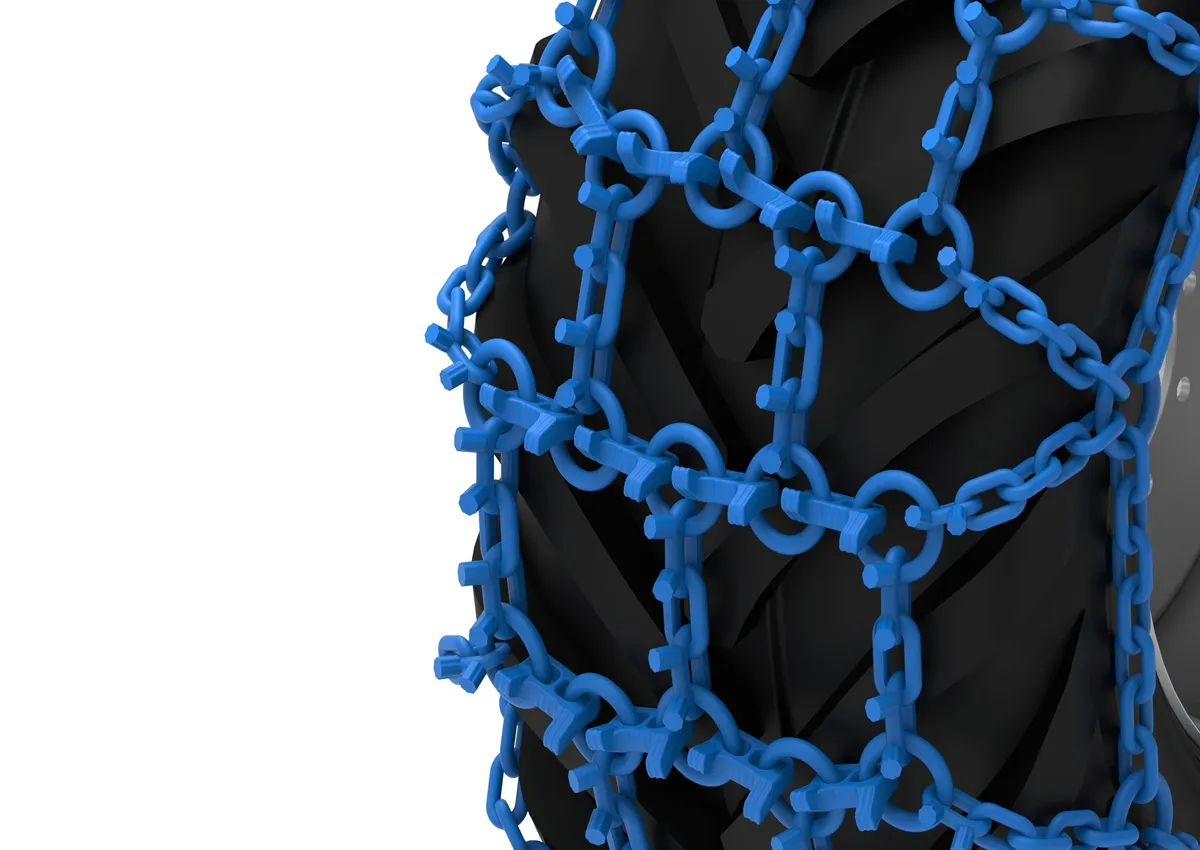
Updated forstgrip pro – 16 mm chain featuring newly designed starwave ® forged parts for enhanced traction and extended service life. Thanks to the high number of forged parts in the tread net and its tighter net design, it is ideal for heavy-duty applications in rocky and stony terrain.
Soft, Boggy, or Wet Ground
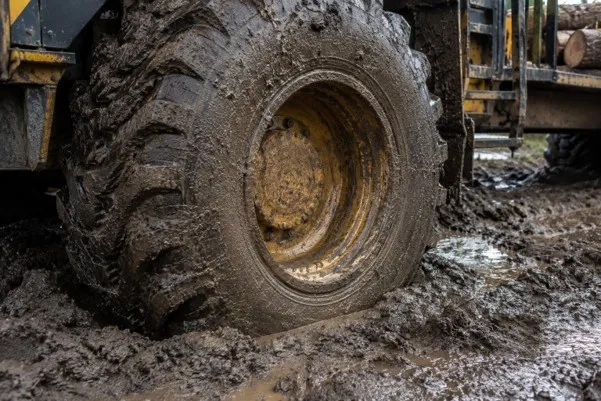
This is where bogie or duo tracks earn their premium. Soft ground such as peat bogs, wet clay or waterlogged extraction zones can punish a chained machine. The machine sinks, spins, and tears up the ground surface, creating ruts that make subsequent passes progressively more damaging. Tracks’ superior flotation keeps the machine moving and minimizes ground disturbance.
The bluetrack wave series with wave and wave wide (even wider cross member), with its wide contact surface, is specifically designed for wet or soft ground scenarios maximising flotation while still self-cleaning mud and debris from between its cross members. Self-cleaning is a critical and often underestimated feature: a chain or track that packs with mud loses its grip function rapidly.
Steep Slopes
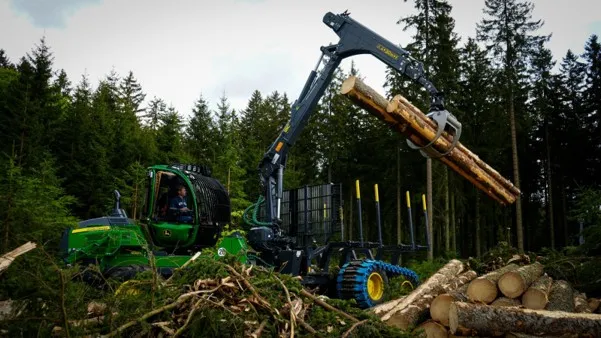
On steep or side-sloped terrain, stability and traction interact in ways that make setup selection consequential for operator safety. Track systems, with their larger footprint and improved ground contact due to stubs, offer better lateral stability particularly when operating across a slope rather than straight up or down. pewag tracks specifically offer the advantage of two stubs per cross member and an offset design, which deliver even greater grip.
The Swedish terrain classification system recognises this explicitly: driving across a side slope steeper than 15° should be avoided where possible and requires detailed planning when unavoidable. On such terrain, every increment of stability matters, and tracks tend to outperform chains.
Chains remain effective on steep terrain for machines operating along the fall line, where the primary demand is traction rather than lateral stability. For operations on very steep ground, the machine often stays closer to established trails anyway, reducing the premium on maximum flotation.
Mixed Conditions Within a Single Operation
In practice, few extraction operations have uniform terrain. A Swedish operator working the boreal interior will encounter frozen ground on north-facing slopes, waterlogged valley bottoms, exposed rock ridges, and soft organic soils sometimes within the same harvesting block. This is where product selection gets nuanced.
Many experienced operators maintain both chains and tracks and switch by season and site. Others choose a setup optimised for the dominant condition and accept lower performance in edge cases. pewag’s range, from bluetrack essential for lighter machines and retrofit applications, bluetrack as the golden middle for everything to the heavy-duty bluetrack+ series, is designed to give operators options across this spectrum without requiring separate machinery for each terrain type.
Forestry in Sweden: A Continent’s Worth of Variation in One Country
Sweden makes an ideal case study because its forestry landscape is extraordinarily demanding and diverse. Nearly 70 % of Sweden’s land area is covered in forest, with productive forestland the dominant land use. The Swedish boreal landscape is a mosaic of different land cover types, from productive coniferous forest to bog and marshland, rock surfaces and subalpine terrain.
The Terrain Classification Challenge
Swedish forestry has developed one of the world’s most detailed terrain classification systems, assessing ground conditions, surface structure, and slope. Ground conditions (the load-bearing capacity of the soil) are shaped by soil type, moisture content, and vegetation, and they vary dramatically across the country.
Northern Sweden (Norrbotten, Västerbotten, Jämtland) combines long winters, thin organic soils over bedrock, and extensive boggy terrain. Southern Sweden has heavier clay soils, milder winters, and conditions that more closely resemble Central European forestry. The central regions present intermediate conditions with seasonal variation that places high demands on both equipment and operator judgment.
The Frozen Ground Dilemma
Traditionally, a large proportion of Swedish harvesting particularly in the north was timed for winter, when frozen ground provided natural bearing capacity. Frozen soil supports machine traffic that would be impossible in summer without severe rutting and compaction damage. For decades, chains were the dominant ground engagement choice for winter Swedish skidder operations, providing grip on icy and compacted snow surfaces.
That calculus is changing. Climate research indicates that increased winter soil moisture and reduced frost frequency are beginning to reduce the carrying capacity of the soil for winter forestry operations in some regions. Warmer winters mean the frozen ground window is shortening, particularly in southern Sweden. This is pushing operations into shoulder seasons when soils are neither frozen hard nor dried out; precisely the transition conditions where flotation becomes critical.
Soil Compaction and Environmental Compliance
Swedish environmental regulation of soil disturbance in forestry is among the strictest in Europe. Rut formation, compaction, and damage to sensitive riparian zones are closely monitored, and operators face both regulatory obligations and social license pressures to minimise ground impact.
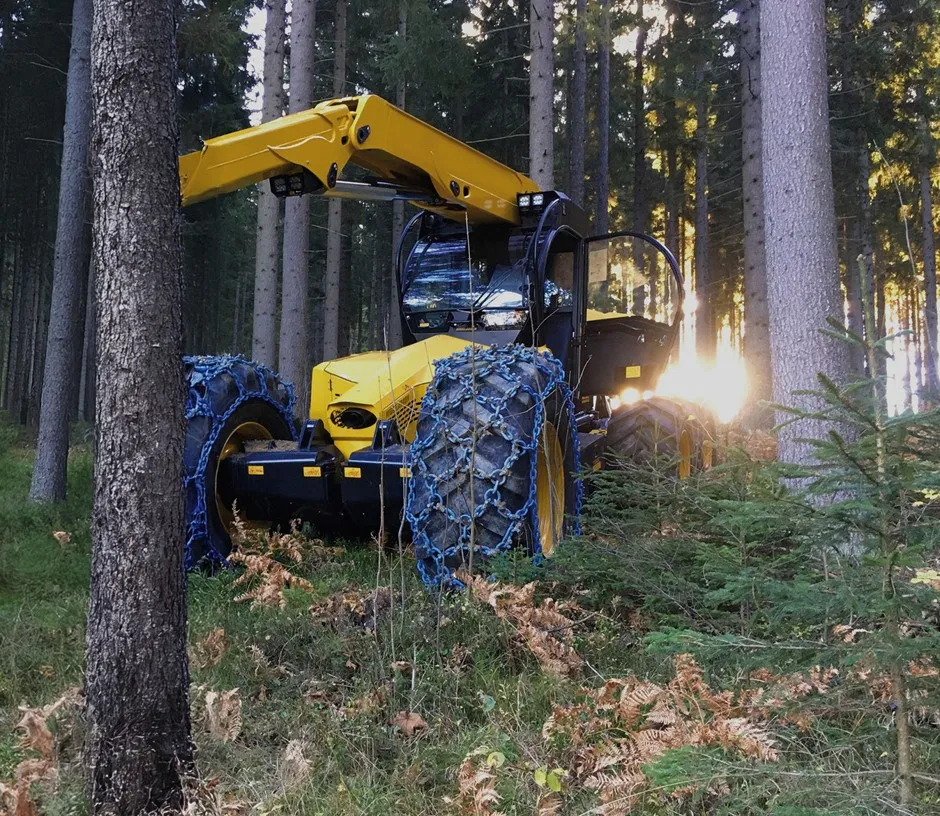
Research on Swedish harvesting operations has shown that soil type, soil moisture, traffic intensity, and road reinforcement all influence rut formation significantly. Tracks reduce surface rutting compared to chains alone, making them an increasingly important compliance tool in wet-season or sensitive-zone operations. In addition, tracks should be used for operations near watercourses, which are regulated under Sweden’s strict forest water frameworks and where minimising ground disturbance is not optional.
Seasonal Strategy: What Swedish Operators Choose
In practice, experienced Swedish forestry contractors tend to use a tiered approach:
Winter (frozen ground, snow, ice): Chains – typically forstgrip pro with forged parts for maximum bite on hard, icy surfaces where flotation is less critical than grip.
Spring thaw and autumn wet season: Tracks – particularly bluetrack duo wave for soft and wet conditions – to maintain mobility and minimise ground damage when soils are saturated.
Summer dry conditions: Light chains or bare tyres on firm, dry ground; heavier setups reserved for inclined or transitionally wet terrain.
Year-round rocky terrain: forstgrip series chain solutions with hard-wearing stubs, prioritise abrasion resistance over flotation.
This flexibility is only possible because modern track and chain systems are designed to be installed and removed in the field without specialist equipment. pewag bluetrack systems are engineered for straightforward fitting, making mid-season transitions practical rather than theoretical.
Machine Size and the Weight Factor
The choice between chains and tracks is also influenced by machine weight and class. Lighter forwarders have different footprint-to-weight ratios than heavy extraction machines, and the optimal solution differs accordingly.
For light to medium machines, pewag’s bluetrack essential line offers an accessible entry point with good traction with two stubs per cross member in the offset design and the iconic pewag starwave® profile for increased grip and off-road capability at a lower purchase price, with self-cleaning performance from the reduced number of cross beams. The bluetrack essential line is also a lightweight option which offers benefits when machines are transported on road. It’s also positioned as an ideal retrofit solution for operators adding ground protection to existing machines.
For heavy machines (especially forwarders) in demanding conditions where the machines doing the hard extraction work on steep, soft, or mixed terrain, the bluetrack+ line is designed for no-compromise performance. Two stubs with offset design per cross member, starwave® profile geometry, high-quality forged connecting elements, and case hardening all contribute to a product designed for machines that cannot afford downtime. Increased comfort due to more cross member and better stability to increased weight and finally an increased lifetime on the bluetrack+ when you think about the total cost of ownership.
A Practical Decision Framework for Forestry Traction
When selecting between chains and tracks for a given operation, five questions guide the decision:
1. What is the dominant soil bearing capacity? Hard, frozen, or rocky ground favours chains. Soft, wet, or organic soils favour tracks.
2. What is the slope profile? Steep cross-slopes increase the value of track stability. Moderate grades on firm surfaces are well-served by chains.
3. What season is the operation? Winter frozen or hard ground operations favour chains. Wet shoulder seasons, deep powder snow and summer extraction in sensitive areas, favour tracks.
4. What environmental compliance obligations apply? Operations near watercourses or on sensitive soils may require the reduced rutting profile that tracks provide.
5. What is the machine class? Match the product line to the machine weight and application intensity: bluetrack essential for lighter or retrofit applications, bluetrack as the golden middle for everything and bluetrack+ for heavy professional and demanding work.
The Cost Equation
Tracks are marginally more expensive than chains. A complete set of tracks for a forestry machine represents a higher investment, and this may be a consideration. However, the full cost analysis includes factors on both sides of the ledger.
Tracks extend tyre life by protecting the tyre from ground contact and reducing slippage-driven wear. The optimised fit of bluetrack duo tracks to tyrecontours prevents the machine from sinking unnecessarily, reducing fuel consumption and improving extraction efficiency. In addition, tracks are gentler to the tyre material compared to chains. Reduced ground disturbance means fewer trail rehabilitation costs and reduced regulatory risk. In conditions where tracks prevent a stuck machine, which can cost hours of downtime and potentially require assistance, the productivity case for the higher investment becomes straightforward.
Conclusion: Terrain First, Product Second
The most experienced operators in demanding forestry environments, and Sweden is as demanding as forestry gets, understand that ground engagement is not a set-and-forget decision. It is a dynamic choice, made season by season and site by site, based on a clear-eyed reading of the terrain.
Chains remain the right answer on hard, frozen, rocky, or icy ground where grip is the limiting factor. Tracks are the right answer on soft, wet, boggy, or sensitive ground where flotation and soil protection are paramount. Many serious operations need both, used at the right time and in the right conditions.
pewag’s forestry range from forstgrip essential and forstgrip chains through bluetrack essential, bluetrack to the premium bluetrack+ line, is built on the premise that operators shouldn’t have to choose between performance and durability, or between protection of their machine and protection of the ground. The right setup for your terrain exists. Getting it right is how you stay productive, stay compliant, and stay ahead.
For product specifications, size matching, and expert guidance on chain and track selection for your machine and terrain, contact pewag’s team of experts or explore our range of forestry chains and tracks online.
Discover More
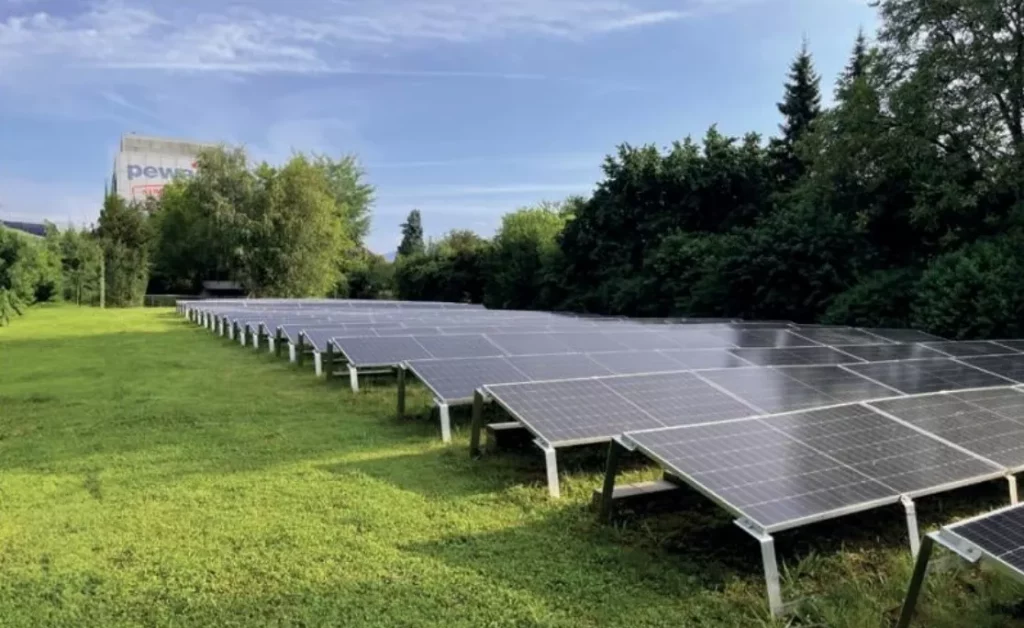
pewag UK has been awarded a Silver Certificate through Speedy Hire’s Net Zero Recognition Scheme, which recognises suppliers for their progress towards Net Zero.
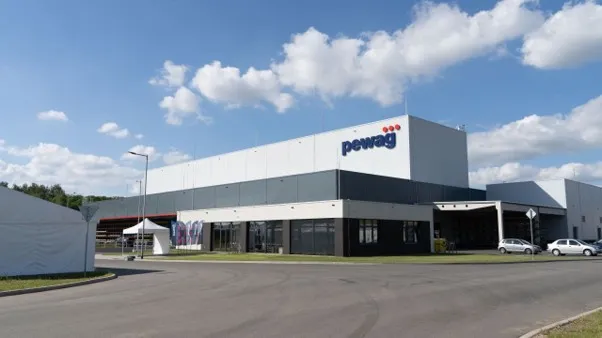
The opening of pewag’s new production facility in the Czech Republic was a chance for team members and customers to get together.
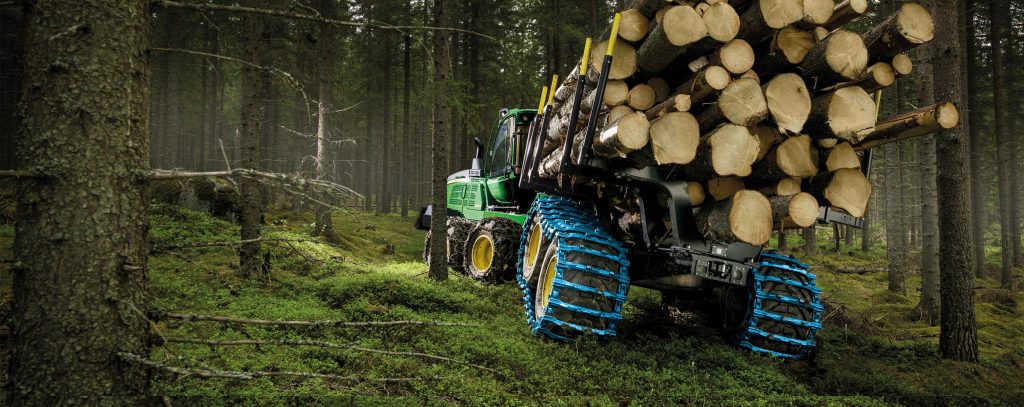
pewag forestry tracks are engineered to deliver reliable grip on forest terrain. Explore the bluetrack range.